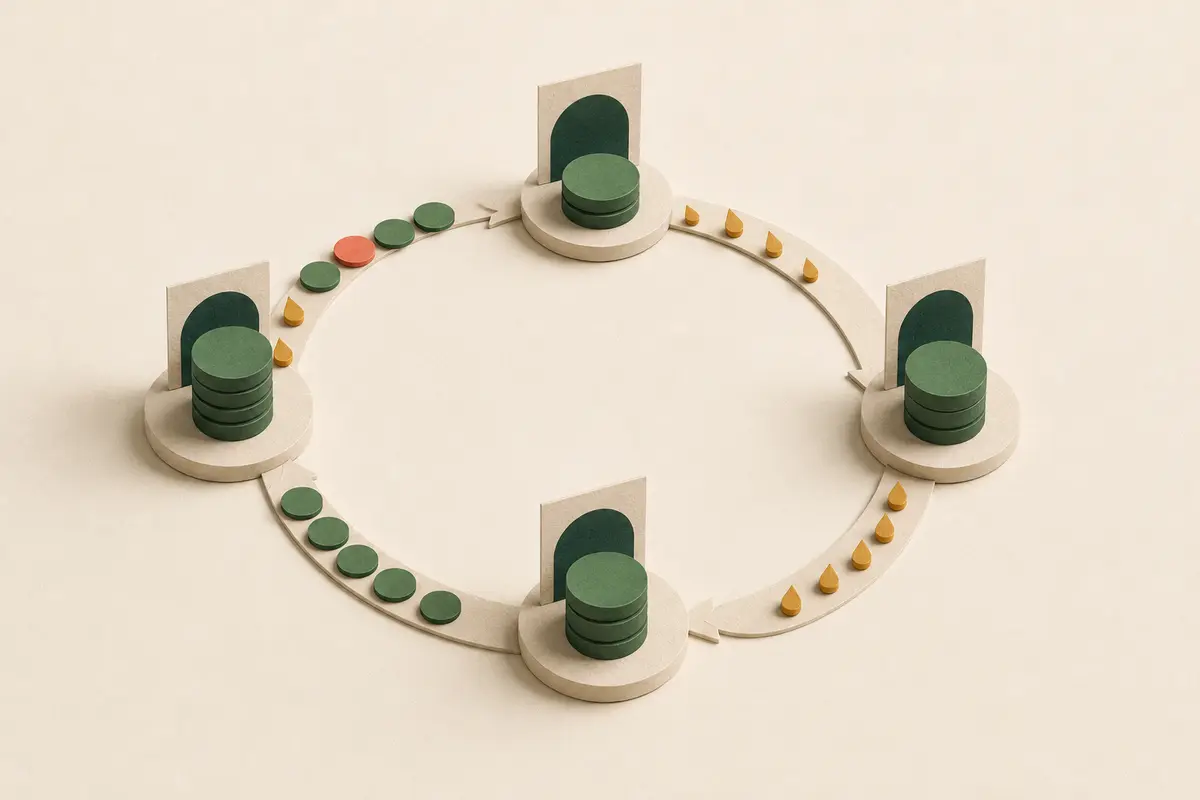
How can reinvested dividends change share count and ending value?
Dividend reinvestment compounds by using cash distributions to acquire more shares, which can then generate later distributions. The model depends heavily on the assumed yield, price growth and time period.
Growing value with distributions retained
Each year: Income = Shares × Dividend per share Shares = Shares + (Income ÷ Share price) Share price × (1 + Price growth%) Dividend per share × (1 + Dividend growth%)Final value = Shares × Share priceKeeping dividend cash invested
The default projection starts with an initial investment and applies the configured return assumptions over the entered years. Reinvestment keeps distributions inside the model instead of treating them as withdrawn cash.
Illustrative inputs; currency amounts below use USD. Rates and prices are assumptions, not live quotes.
- Shares owned
- 200
- Share price
- $45.00
- Annual dividend per share
- $2.10
- Dividend growth per year
- 5%
- Price growth per year
- 6%
- Years
- 15
Step-by-step calculation
- Year-one dividend = 200 × 2.1 = 420. Reinvest at 45 to buy 9.333333 more shares.
- For the next year, multiply the price by 1.06 and dividend per share by 1.05. Repeat income, reinvestment and growth in that order for 15 years.
- The resulting 379.928471 shares are worth 40,973.431067 at the final modelled price; cumulative dividends reinvested are 13,014.718904.
Intermediate figures are rounded for reading. Results use the full calculation precision.
Time magnifies repeated reinvestment
Separate the ending value from total contributions and estimated dividend effect. A longer horizon gives repeated reinvestment more periods to influence the result.
Constant-return assumptions in the projection
A constant yield does not mean a constant dividend per share when price is also changing. This calculator follows its displayed formula and is not a schedule of actual company payments.
- Return inputs remain constant throughout the projection.
- Dividends are reinvested according to the timing represented in the formula.
- Tax, fees, fractional-share restrictions and dividend cuts are excluded.
Calculations related to dividend reinvestment
The following tools examine neighbouring parts of the same calculation without changing the inputs or assumptions used above.
References
Sources and conventions
- SEC Investor.gov: shares and dividends
- SEC Investor.gov: compound growth
A comparison tool for compound growth assumptions, not a promised investment return.
Quick answers
Frequently asked questions
Does dividend reinvestment buy fractional shares?
Yes. The formula adds dividend income divided by share price without rounding the new share count.
When are price and dividend growth applied?
Each simulated year first reinvests that year's income, then increases share price and dividend per share for the next year.
Are taxes and reinvestment fees included?
No. All calculated dividend income is reinvested without tax, commission or withholding deductions.
Calculation method and limitations · Report an error
Educational content only. This guide is not financial advice.