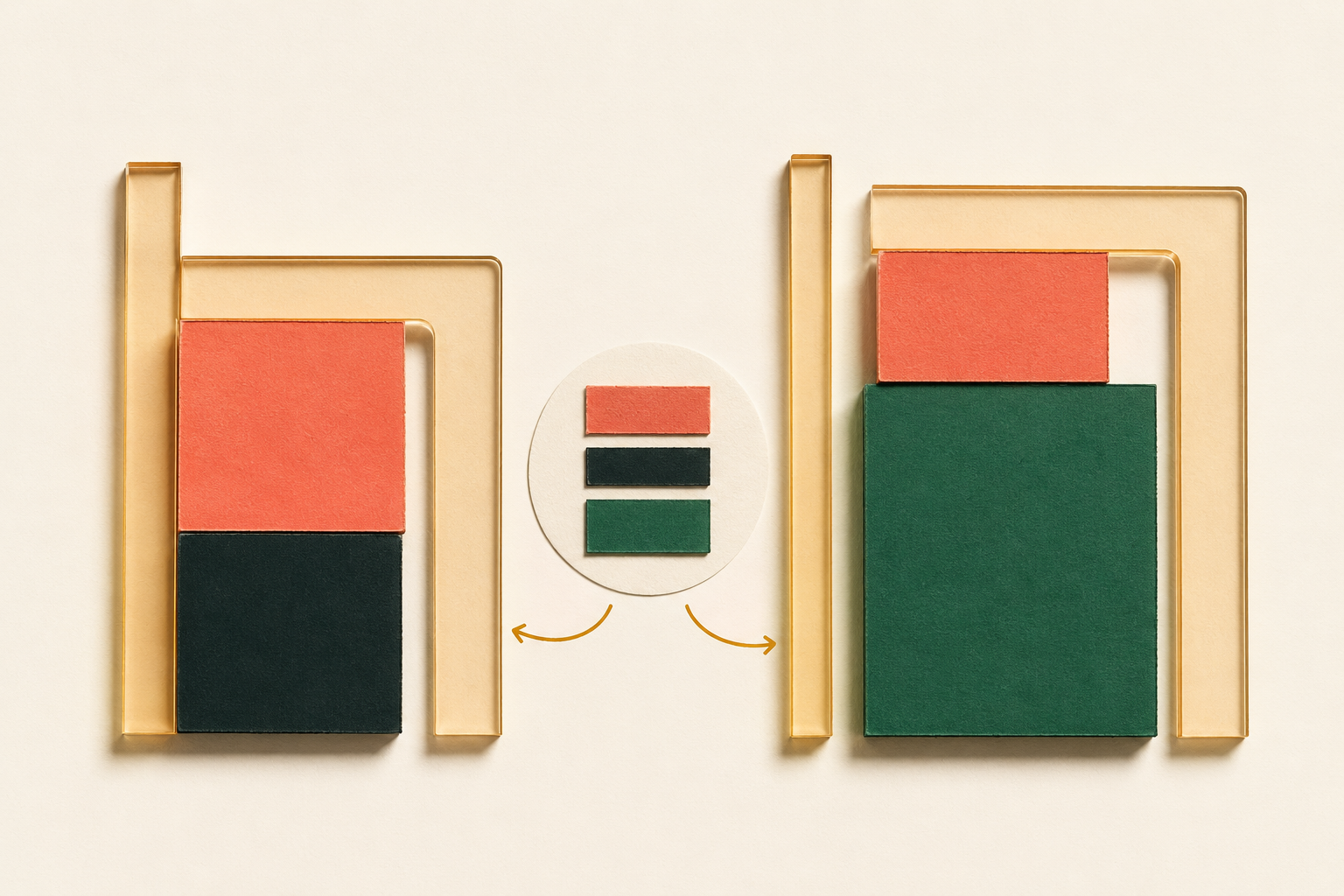
A product costs 60. You add 40%. The selling price becomes 84. So the margin is 40%, right? Nope. It is 28.6%—and that difference can quietly wreck a pricing plan.
Markup and margin describe the same profit from different starting points. They sound interchangeable, which is exactly why the mistake survives in spreadsheets, quotes and team conversations.
The trap in one sentence
Markup measures profit against cost. Margin measures profit against the selling price. Because the selling price is higher than cost, the same profit becomes a smaller percentage when expressed as margin.
Put any cost and markup into the Markup vs Margin Calculator to see the selling price and resulting margin immediately.
Two formulas, two different bases
(Profit ÷ Cost) × 100(Profit ÷ Selling price) × 100The arithmetic is easy. The business consequence is not. If a target margin is entered as markup, every sale starts below plan before discounts, payment fees, returns or overhead appear.
What markup actually creates a 40% margin?
With a unit cost of 60, a 40% margin requires a selling price of 100. Profit is 40, and 40 divided by the selling price of 100 gives the target margin.
Once you know revenue and cost, the Profit Margin Calculator gives margin, gross profit, markup and cost ratio in one view.
Discounts expose the mistake fast
Return to the $84 selling price. A 10% discount reduces it to $75.60. With cost still at $60, profit falls to $15.60 and margin drops to 20.63%. A discount that looks modest has removed 35% of the original $24 profit.
Use the Percentage Calculator to test price changes, then recalculate margin from the discounted revenue. This is especially useful when promotions are planned by one team and margin is owned by another.
A pricing workflow that avoids the trap
- Define the full unit cost on a consistent basis.
- Set the margin the business needs after direct cost.
- Convert that margin target into the required selling price.
- Stress-test planned discounts and transaction fees.
- Label every spreadsheet percentage as markup or margin.
References
Sources and conventions
- OpenStax: percentage arithmetic
Mathematical background; any tax, tip or discount percentage in the example is user-supplied.
- SBA: single-product break-even analysis
Quick answers
Frequently asked questions
Is 40% markup the same as 40% margin?
No. A 40% markup on a cost of 60 creates a selling price of 84 and a profit margin of about 28.6%.
How do I convert markup to margin?
Divide markup by 100 plus markup, then multiply by 100. A 40% markup becomes 40 ÷ 140 × 100 = 28.6% margin.
What markup gives a 40% margin?
A 40% margin requires a 66.7% markup. With a cost of 60, the selling price must be 100 to leave 40 in profit.
Calculation method and limitations · Report an error
Educational content only. This guide is not financial advice.