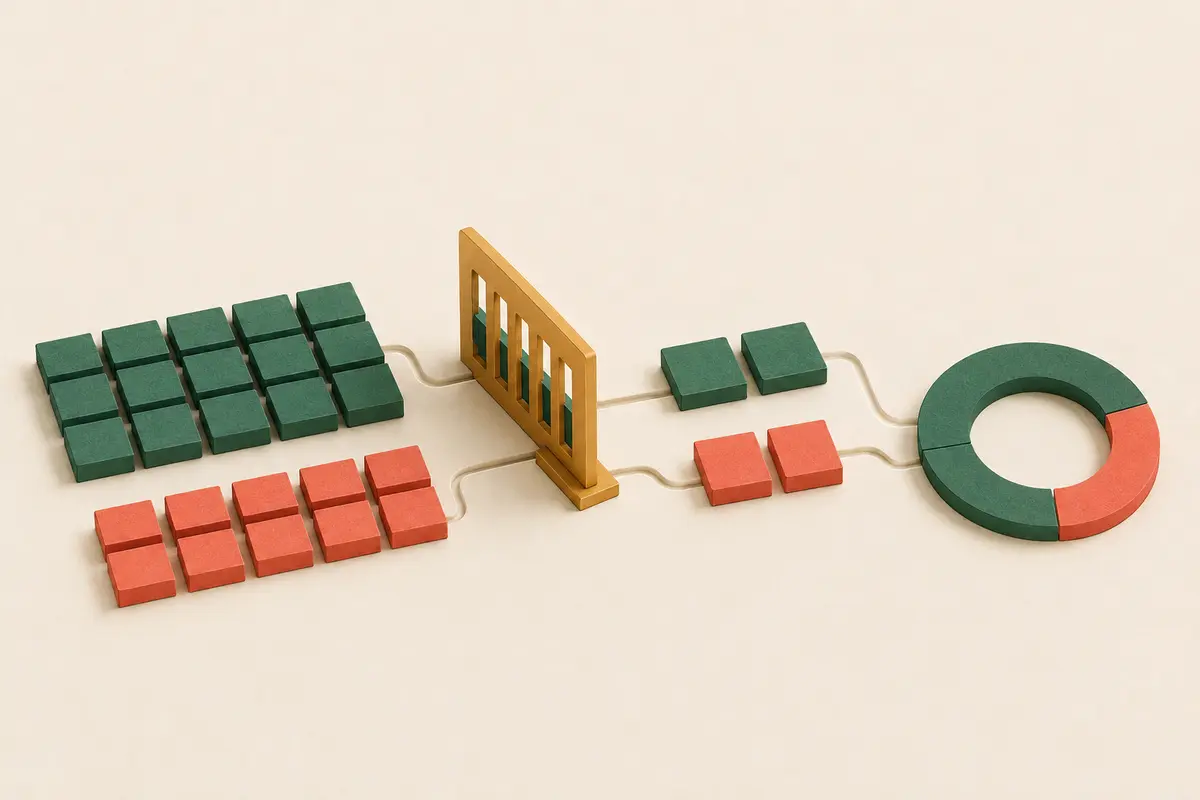
How can two quantities be simplified into a ratio and compared as a percentage?
A ratio preserves the relative size of two quantities. Simplification divides both sides by a common factor without changing that relationship.
Dividing both sides by a common factor
Divide both values by their greatest common divisor.Decimal = A ÷ BShare of A = A ÷ (A + B) × 100One pair expressed three ways
The default values are reduced to their simplest integer relationship where possible, while supporting outputs show the decimal or percentage comparison.
Illustrative inputs; currency amounts below use USD. Rates and prices are assumptions, not live quotes.
- First value
- 24
- Second value
- 36
Step-by-step calculation
- The greatest common divisor of the rounded inputs 24 and 36 is 12.
- Divide both sides by 12: 24:36 becomes 2:3. Use whole-number inputs for an integer ratio.
- A's share of the combined amount = 24 ÷ (24 + 36) × 100 = 40%.
Intermediate figures are rounded for reading. Results use the full calculation precision.
Why ratio order matters
A ratio such as 2:3 is directional: the first quantity is two parts for every three of the second. Reversing the order answers a different comparison.
Convert units before simplifying
Ratios require compatible units. Convert metres and centimetres, or hours and minutes, to one common unit before simplifying.
- Both quantities are expressed in compatible units.
- The second value must be non-zero for division-based comparisons.
- Decimal inputs may require scaling before an integer ratio can be simplified.
Calculations related to ratio
The following tools examine neighbouring parts of the same calculation without changing the inputs or assumptions used above.
Quick answers
Frequently asked questions
How is a ratio simplified?
Both values are divided by their greatest common divisor.
What does a ratio written as a decimal mean?
It is the first value divided by the second value.
How do I find the first value's percentage share of a ratio?
Divide the first value by the sum of both values and multiply by 100.
Calculation method and limitations · Report an error
Educational content only. This guide is not financial advice.