How do share count and price change after a stock split?
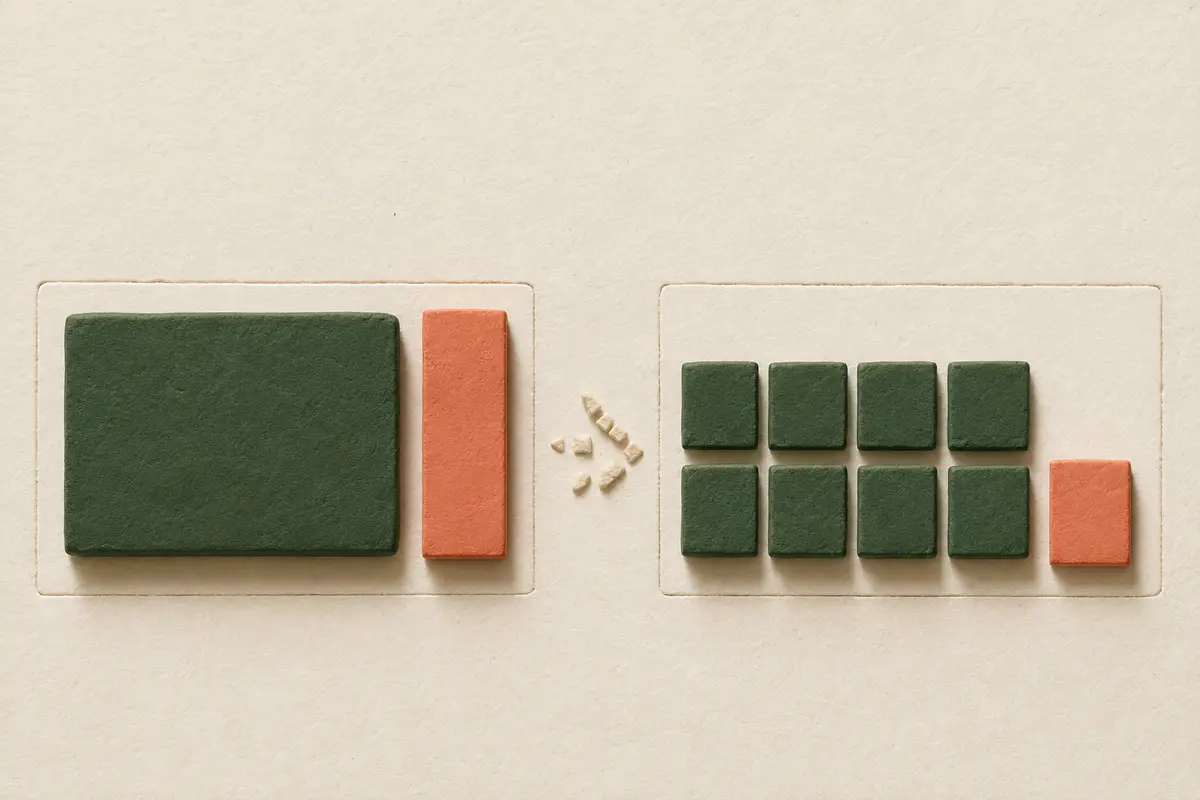
A stock split changes units, not the total position value at the split moment. More shares at a proportionally lower price—or fewer shares in a reverse split—represent the same ownership value before market movement.
Applying the split ratio to shares and price
Factor = New shares ÷ Per old shareShares after = Shares × FactorPrice after = Price ÷ FactorA before-and-after position check
The worked example applies the entered split ratio to the existing quantity and price. It shows the adjusted share count and theoretical post-split price side by side.
Illustrative inputs; currency amounts below use USD. Rates and prices are assumptions, not live quotes.
- Shares owned
- 100
- Price before split
- $480.00
- Split ratio — new shares
- 4
- Split ratio — per old share
- 1
Step-by-step calculation
- Split factor = 4 ÷ 1 = 4.
- New shares = 100 × factor = 400; adjusted price = 480 ÷ factor = 120.
- Position value remains 400 × 120 = 48,000 before any market move.
Intermediate figures are rounded for reading. Results use the full calculation precision.
What happens to per-share cost basis
Multiply the new quantity by the adjusted price to check that the position value is preserved apart from rounding. Per-share cost basis changes by the same ratio.
Rounding and fractional-share differences
Do not record the extra shares as profit. Brokerage displays may take time to update, and fractional-share treatment can create small cash adjustments not represented here.
- The split is applied proportionally to every share entered.
- No market price movement occurs during the arithmetic comparison.
- Fractional shares, cash-in-lieu payments and tax treatment are excluded.
Calculations related to stock split
The following tools examine neighbouring parts of the same calculation without changing the inputs or assumptions used above.
Quick answers
Frequently asked questions
Does a stock split increase the value of my position?
No. Under this calculation, more shares are offset by a proportionally lower price, leaving position value unchanged.
How do I enter a 3-for-2 stock split?
Enter 3 as the new-shares value and 2 as the old-shares value.
Can this calculate a reverse stock split?
Yes. A ratio with fewer new shares than old shares, such as 1 for 10, produces fewer shares at a proportionally higher price.
Calculation method and limitations · Report an error
Educational content only. This guide is not financial advice.